Connect with the Deaf Community and Elevate your Career
Launch a gratifying career working with the Deaf and hard-of-hearing community by learning American Sign Language (ASL) at NOVA. Choose from the following degrees and certificates.
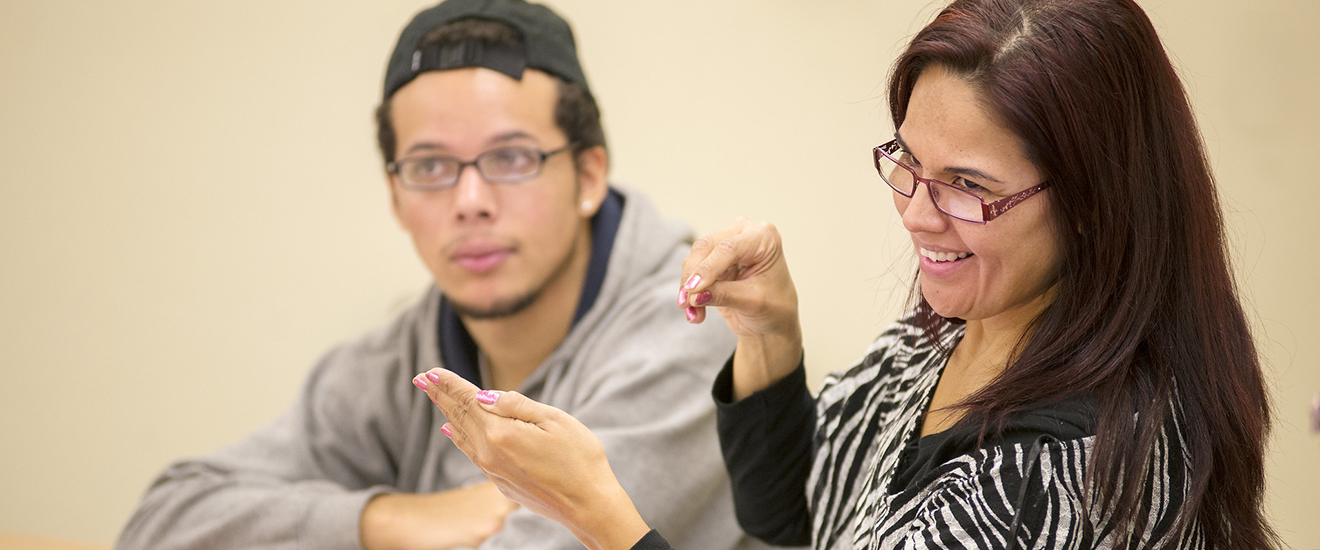
Launch a gratifying career working with the Deaf and hard-of-hearing community by learning American Sign Language (ASL) at NOVA. Choose from the following degrees and certificates.
Get comprehensive training for sign language interpreter jobs with NOVA's Associate of Applied Science (AAS) in American Sign Language to English Interpretation. NOVA's program prepares you for ASL interpreter certification on state and national levels, including under the Virginia Quality Assurance Screening (VQAS), National Registry of Interpreters for the Deaf, and Educational Interpreter's Performance Assessment.
Learn the basics to better serve the Deaf and hard of hearing community with NOVA's Career Studies Certificate (CSC) in American Sign Language. NOVA's program helps you develop fundamental ASL skills you can immediately use in teaching, health care, social services, public safety or other settings. It is also helpful for determining whether an ASL associate or bachelor's degree is for you. Many NOVA students go on to earn their associate degree in interpreting or Deaf studies after earning this certificate.
You'll learn from dedicated, supportive ASL faculty with years of experience in Deaf education, interpretation, and interpreter training.
You'll practice using and interpreting ASL in interactive courses that prepare you to succeed as an Interpreter after graduation.
You'll learn ASL affordably and within your budget. You may even qualify for NOVA scholarships to help offset the cost of tuition.
Northern Virginia Community College is accredited by the Southern Association of Colleges and Schools Commission on Colleges (SACSCOC) to award the associate degree in American Sign Language and ASL certificates.
Credit for prior learning (CPL) generally refers to the process of granting college credit for learning gained in nontraditional ways, including but not limited to: certifications, AP or IB exams, military training, or life experience.
Learn more about possible transfer opportunities associated with this program of study. Students interested in transferring should contact an advisor or counselor to further discuss their plans.